I think we need a name for a certain kind of phenomenon—the act of looking at an obvious performance and just falling for it wholesale. The existing words we have don’t quite capture what I’m getting at. Gullibility and naivety, although it is those things, don’t fully convey the wilful one-sidedness and self-deception that this behaviour involves, nor the particular way in which it unfolds today online.
In the last Friday Reflection I talked about the three movements of insight, or three levels of awareness, a person can have into their own behaviour. There is also an outward equivalent to this model as the three levels of insight you can have into other peoples’ behaviour. It’s the same thing only applied externally, and is especially relevant for understanding social media today and the various concepts being spun up in our attempts to make sense of it and our culture’s response to it.
At the first level there is simply seeing what you see and taking it at face value, buying into the performance being presented to you and missing the full reality. The second occurs when dissonance starts to make itself known—desire meets with the slight suspicion or fear that what you see might not be the full story, or that the true motives behind it might not be what they appear. The third involves confronting the reality as it really is, being willing to hold both needs simultaneously—for what is being offered to you in the right hand, and what is being deliberately hidden from you in the left.
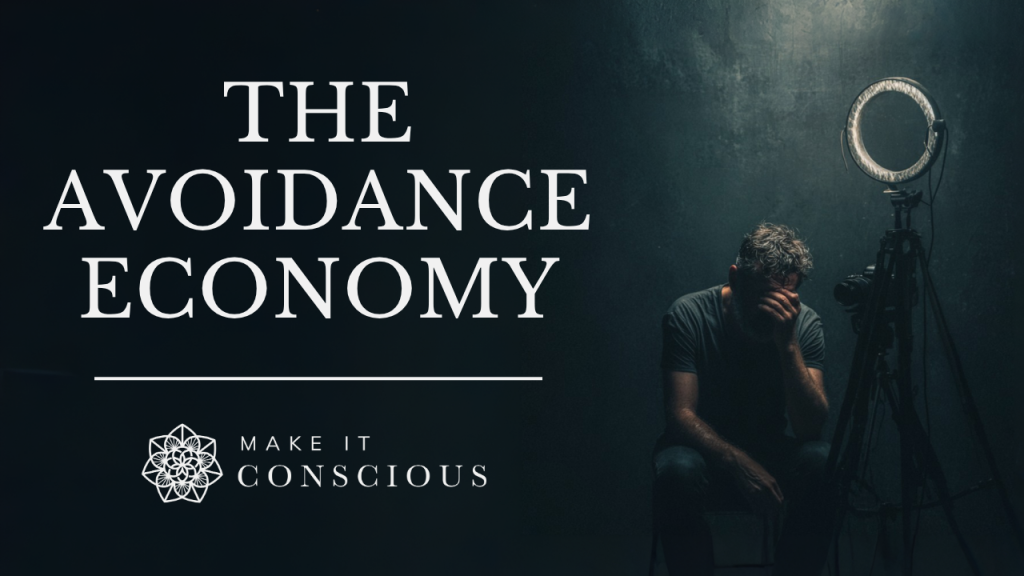
Do you see a man crying? Or a man making a video of himself crying?
It’s not original to write about the many problems presented by social media. So I guess my critique is right on-brand. But there are two reasons I am doing it this week.
The first is that high-profile falls from grace just seem to be coming thicker and faster, to the point where there’s virtually no one who isn’t noticing. To have your mask slip publicly and disastrously now seems standard for anyone with a sizeable following, rather than the exception of a few deceptive stragglers who somehow slipped through the filter.
The second reason is that the tools we have to meet with this fact are still entirely inadequate. There is no widely acknowledged framework for accurately conceptualising what just happened, why so many were deceived in this particular way or even the nature of the deception itself. Let alone why it keeps happening.
It should be clear that this situation is reaching a crescendo. Yet the most apparently advanced theories making their way through the system simply notice the dissonance, label it as irony, and pretty much consider it dealt with. But this is simply to slip back to the first step only with a different flavour, and fails to complete the movement. The very people ostensibly critiquing it are themselves captured by the same dynamic, serve it loyally, and are unable to see out of it—media personalities under another guise—while hardly anyone stops to question why we need a mask at all.
It’s not that you’re not a philosopher, a fitness coach, an intellectual, an investor, a beekeeper or whatever. But be honest about the fact that you are also, and in fact foremost, a media personality.
There’s nothing wrong with being a media personality, a performer, or any other thing you purport to be. But there is a problem with claiming it is one thing when really it’s another.
Such people want to be everything and to ‘have it all.’ They are refusing to learn the value of sacrifice and of precisely not having it all. They want to have freedom but without limitation (which is really a euphemism for power) and the only way they can achieve some sense of this is to hide half of themselves from themselves. They drag others in who hope to learn and ‘get value’ from them, but the best media personalities are rarely the best teachers, the best philosophers, the best at what they purport to do. Even those who ‘look like’ the real deal at a glance, who hide out on the sidelines, are often just acting out the same pattern. Those who get the most attention are generally not the best at what they claim to be, the most authentic or the least self-deceived, but those who perform in the role of media personality while their followers must be led to believe otherwise.
Whatever your role in life—whether you work for someone else or run a business, are an artist or attempting to make any kind of contribution—the pervading assumption is that you need to be on social media. And not only on social media, but performing for an audience and ideally constantly. Even if it’s just on LinkedIn.
Ten years ago this was actually quite a novel even controversial idea. What business does a backwater industrial estate fulfilment warehouse have prancing about on instagram?
When asked at the time how social media can possibly pay for itself, industry guru Gary Vaynerchuk famously quipped “what’s the ROI of your Mom?”
Aside from being a terrible, tacit put-down of his mother, it sidestepped a perfectly reasonable question.
‘ROI’ is an unfortunate term because the ‘payoff’ might not be financial at all. But for something to be worthwhile it should have a role in moving you and others forward in some way. If an activity doesn’t have an ‘ROI,’ financially or otherwise, then it must by default be a tax and another form of self-avoidance. Businesses have always found ways to waste life away under the guise of productivity, and your activity on social media may in large part just be the latest iteration of that.
I’ll be the first to point out that any measure of value—money, time or otherwise—is limited and one dimensional. But most people and businesses do not measure the impact of the energy they expend in social media in any meaningful way. They either use meaningless measures, perverse measures or they just don’t think about it at all. And often the reason they don’t think about it is because they don’t actually want to follow where it leads. The activity is serving a different purpose to what they claim it is. They could be shouting into the wind and not even know it.
Im not at all suggesting you weigh up every decision in a utilitarian way, but if you knew that for every hour you spent broadcasting to the world, only half an hour of attention was directed back at you, it should at least arouse some self-reflection.
This points to the crux of the illusion being perpetuated here, and the hidden piece that needs to be reconciled with. Social media is, essentially, another means of communication; it doesn’t change the underlying calculus of communication itself. Sure you can amplify your voice, but so can everyone else.
We still live in a finite world. Human connection still isn’t and will never be merely an external resource to be exploited, and treating it as such will always be a violation that leads to inner and outer consequences. On the other side of every follower is a followee; every watch hour you receive is also an hour that someone else gives; and the average social media account still has exactly one follower for every person being followed.
A world where everyone is a media personality is impossible mathematically let alone morally. And yet that’s the world many would have you believe we are heading towards. It may be ‘zero sum,’ but if you see it as a ‘game’ to be ‘won’ you’ve already lost yourself.
The promise of getting ahead in this way is a lie. Attention has always been limited, even if avoidance takes on ever new and tantalising forms, so give and receive it wisely.