
Not rules to be followed, but principles to be understood.
Becoming undivided in yourself is the result of what you do each moment of every day: the choices you make, your intention and your willingness to take responsibility. The Seven Habits of Individuation are a method for that work, and anyone can apply them in their own way.
The habits are practical, but they are also tools for thinking, as much about understanding and intention as about action. Almost everything in the Make it Conscious Method™ can be mapped to them in some way.
Lights on the dashboard of your mind
You can take the habits as a practice: endeavour to communicate truthfully, not to complain about what you aren't willing to act on, to do something useful in the world, to self-reflect each day. They are useful as a guide. Hold any of them as an absolute, though, and the world will find a way to test you and shake you out of it.
They also work like lights on the dashboard of your mind. When you find you can't practise one, or simply aren't, that points to unconscious content worth looking into. You might feel fine, as far as you are aware, and still catch yourself complaining. That is a light coming on: something in your mind was driving the complaint before you were aware of it.
Take Responsibility for Your Mind
Choose a habit on the ring to see its three facets. Tap a facet to read about it.
Read about this habitThe seven habits and their twenty-one facets
In the first three habits the facets mirror one another: the first concerns the unconscious, the second Eros and the third Thanatos.
- Habit 1
Responsibility
Take Responsibility for Your Mind
The foundation of the other six. Everything you experience is rendered by mind, though not necessarily caused by your mind, and taking responsibility for it turns what you meet into material for self-knowledge.
Understand the unconscious
Honouring its existence and learning how to relate to it, above all through your own experience. What am I not seeing?
Understand Eros
The mind's desire to go out and meet the world, which is how you discover yourself. Where that desire becomes compulsive, it points to something unconscious. What do I really want?
Understand Thanatos
The need to come back to the self: the energy that sees what isn't being accounted for and pulls it apart, destructively or creatively. What am I pushing away?
One goes out and the other comes back. This is how the mind knows itself.
- Habit 2
Empathy
Cultivate Wholesome Intentions
A decision, made on the understanding of the first habit, to honour the journey towards self-knowledge and align yourself with it. Empathy belongs here: the willingness to meet experience and be changed by it, in yourself as much as in others.
Connect
Since the unconscious exists, choosing to be in touch with it rather than turn away. When a tension arises, you work to understand it, and that simple decision resolves a great deal by itself.
Temper Eros
Being drawn compulsively to something isn't a problem in itself: it points to unconscious content. Letting go isn't something you do: it happens once that content has been made conscious.
Temper Thanatos
Choosing to love, as simple as it sounds: it stops resisting, and allows engagement and healing to happen. To love another is to honour their freedom.
- Habit 3
Communication
Skilful Communication
Here intention becomes action. Communication is how you speak with yourself and how you influence the people and the world around you, and it reaches well beyond speech: a glance, a gesture, a message, a post, the way you present yourself.
Truthful
Communicating what is true honours the unconscious and what is. That means more than avoiding outright lies: omission, exaggeration and minimising count too, and so does being honest with yourself. Every lie creates a split in the mind, and that has psychic consequences.
Purposeful
Communicating purposefully rather than frivolously means not burdening other people with your unchecked needs, which honours their freedom. The urge to chatter, fill a silence or gossip usually serves a need that hasn't been made conscious, and catching it is a light on the dashboard: why am I doing this?
Empathic
Kind, though not always outwardly "nice": the willingness to engage with yourself and others rather than push them away or avoid the tension. Passive aggression is still aggression.
- Habit 4
Contribution
Contribute Your Unique and Specific Value
Accepting and being yourself at work, and beyond that, contributing yourself: what you uniquely have to offer, brought together with what the world needs.
Know your unique set of facts
What can I actually do, what are my skills, what have I spent my life practising? You find out by living: trying things, and learning what isn't you.
Contribute to the needs of the world
What would actually be of value? Not meeting expectations for their own sake, but being yourself while solving problems people genuinely have.
Be generous
Generosity is generative: it brings two things together to make something greater than the sum of its parts. You work on yourself as much as you produce something in the world.
- Habit 5
Discipline
Manage Your State
Using energy actively to iron out your own inner contradictions and move towards greater alignment with yourself. The three facets are three ways of using it.
Proactively
Going towards conflict that lies dormant in the mind, rather than waiting for a pattern to re-emerge in a more destructive form. Confidence comes from having faced fears voluntarily.
Responsively
Responding to what arises, rather than reacting on impulse. If you feel anger, there is a reason for it, and it needs to be understood rather than acted out or pushed away.
Constructively
Building surroundings that support the work you do on yourself. Your surroundings feed back into your mind, and your mind into your surroundings.
- Habit 6
Concentration
Concentration
The ability to choose where your attention goes, instead of having it pulled in every direction by whatever is stirring just below the surface of the mind. It collects the mind: it remembers rather than dismembers. Where the fifth habit is wilful, this one is about allowing.
Recognise
Noticing when something is out of alignment, in your mind, your body or your feelings. It is easy not to notice you are in tension, because there is a tendency to avoid it. Recognising comes with accepting: no longer resisting what is there, and allowing it.
Bare attention
Directing attention to raw, felt experience, before the mind labels it or draws meaning from it: closing the aperture on one sound, one sensation or one feeling, and staying with it as it is.
Clear comprehension
Seeing causes and consequences for yourself, through experience rather than by working them out: how past actions made the present, and how present actions will make the future. Why am I doing what I'm doing? Where bare attention narrows the aperture, clear comprehension opens it.
- Habit 7
Practice
Dedicated Inner Work
Time set aside for self-reflection and nothing else: that is what makes it dedicated. If the first habit is the foundation, the seventh is the pinnacle. Its facets are three tiers, from the widest view to the finest detail.
The macro tier
Divination, with tools such as tarot, astrology, your birth chart and dream work: understanding the bigger picture and the forces at play. It is the study of symbolism, a way of knowing yourself, not of telling the future.
The deep tier
Active imagination: consciously engaging with the images and symbols of your own unconscious and coming to terms with them. It brings pivotal insights and builds a relationship with the unconscious.
The fine tier
Meditation: letting the mind settle by itself. It works on the finer, quieter conflicts, letting them come into consciousness, run their course and go.

All shadow work is individuation, though not all individuation is shadow work.
Shadow work isn't only study, or only psychology. It is also how you behave, how you speak, the kind of work you do, how you manage your state and whether you set aside time for self-reflection. The habits are what you do about it in daily life.
The course, in the app
Looking for the free guide? The habits are set out on this page, and the course goes further, in the app.
The course, The Seven Habits of Individuation, is in the Make it Conscious app: thirty video lessons on every habit and its facets, with guided exercises and prompts to reflect on. The welcome and the course overview are free.
The Seven Habits of Individuation
Thirty video lessons
- Welcome Free
- Course overview Free
- The seven habits and their facets
- Guided exercises and prompts
The habits and your Development Pathways
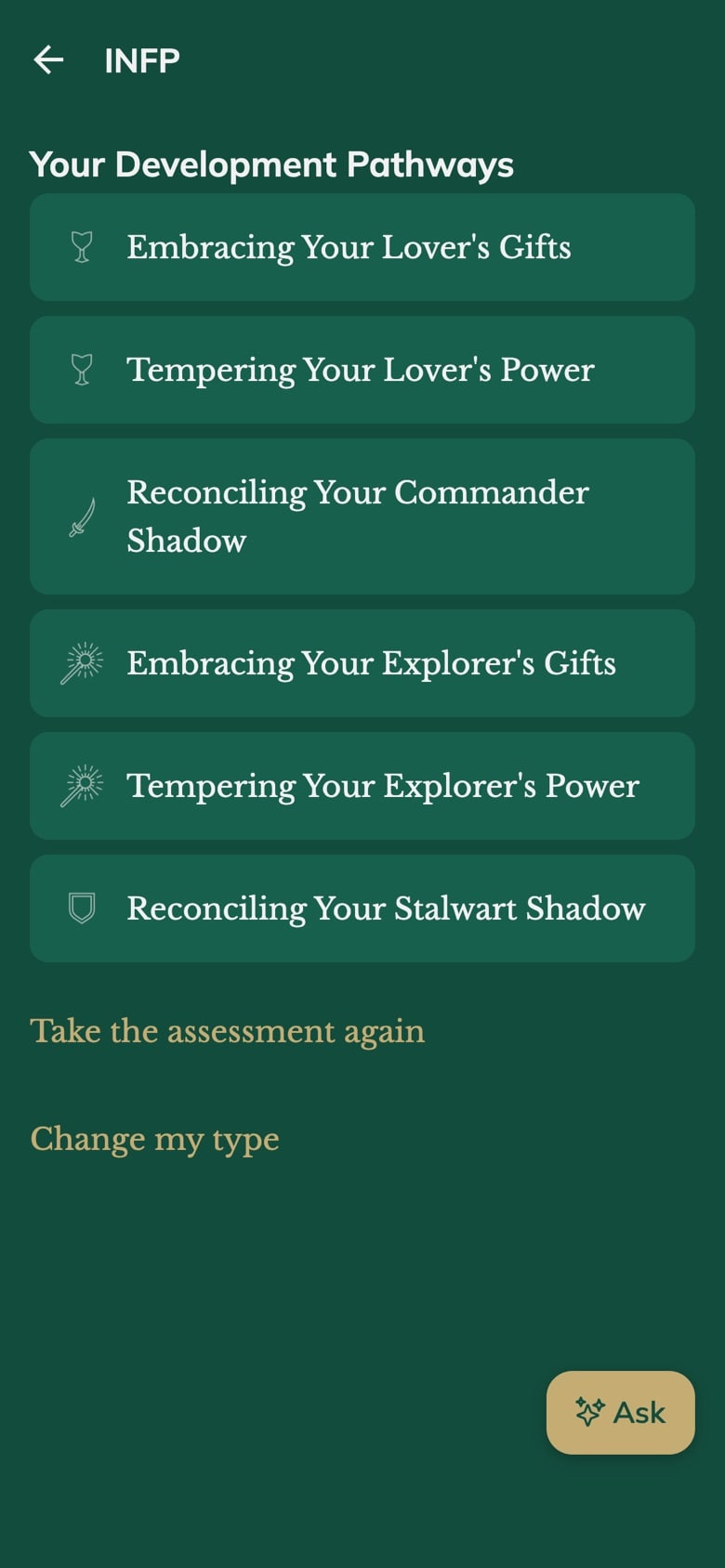
The habits also shape your Development Pathways in the app. Each of the eight functions is matched to the facets that develop it, and your pathways draw their practices from those matches. They point you to the practices that will grow your own personality.
Free personality test
Find out which of the eight functions lead your personality, and which sit in shadow. Your result sets up your Development Pathways in the app.
You'll also receive Make it Conscious emails. Unsubscribe any time.
 Seer
 Explorer
 Stalwart
 Tactician
 Sage
 Commander
 Lover
 Caregiver